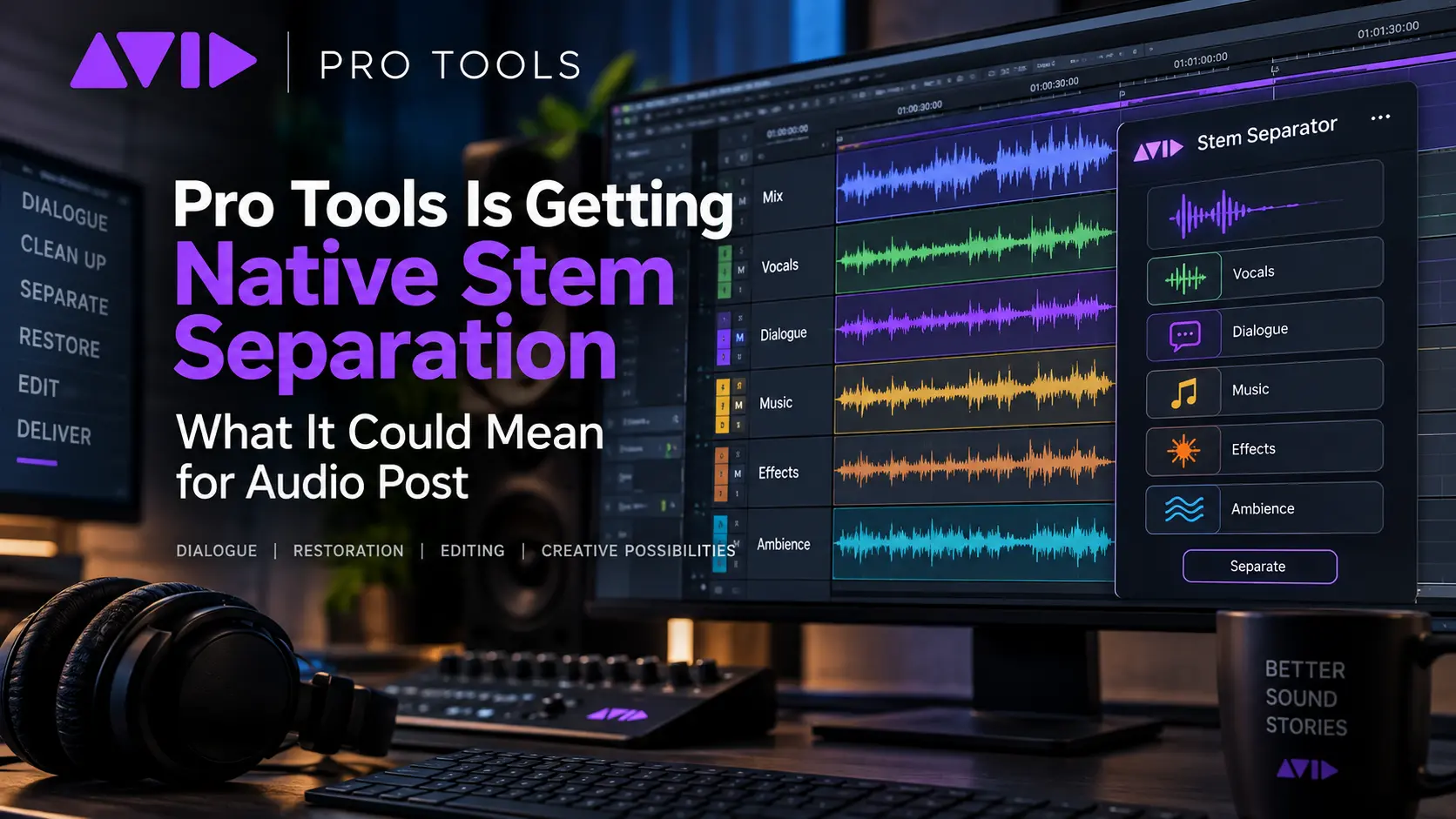
Avid has demonstrated a technology preview of a forthcoming Stem Separator Extension for Pro Tools, bringing a workflow that has usually required a separate application directly into one of the dominant environments for film and television sound.
Shown at IBC 2026, the preview is designed to take a stereo source and separate it into component parts inside Pro Tools. Stem separation itself is not new, but its arrival as an integrated Pro Tools process could be more consequential than another standalone separation product.
Why integration matters
Audio post-production is full of jobs in which the technical capability already exists but the workflow carries friction. Moving a clip out of a session, processing it elsewhere, creating new files, importing them, checking sync and managing versions all take time. None of those steps is especially difficult, but repeated across a programme they become significant.
If Avid’s implementation allows an editor to create useful separated material without leaving the session, stem separation begins to look less like a specialist rescue operation and more like an ordinary editorial tool.
The post-production applications are different from music
Music-production demonstrations of stem separation tend to focus on extracting vocals, drums, bass and instruments from a finished mix. Post-production has a different set of problems.
A dialogue editor may receive archive material in which speech and background sound exist only as a mixed recording. A documentary may contain material for which original production stems no longer exist. A scene may contain useful ambience underneath speech that needs to be extended, or dialogue that needs to be isolated before more conventional restoration can begin.
In those situations, separation does not have to produce a perfect, releasable solo stem to be valuable. A partially isolated element can become source material for editing, restoration or reconstruction.
Separation does not replace restoration
There is an important distinction between separating content and making it sound convincing. Artefacts, missing transients, unstable ambience and spectral damage can remain after separation. The output still needs critical listening and, in many cases, further repair.
That is why the most useful question is not whether AI separation can produce an impressive demo. It is whether the result saves an experienced editor time while preserving enough natural detail to survive in context.
For post professionals, the threshold for success is often pragmatic: does this create a better starting point than the original mixed source, and does it do so quickly enough to justify using it?
A broader shift inside Pro Tools
The preview also fits a wider direction in professional audio software. Processes that once sat in specialist offline applications are increasingly being brought closer to the timeline through extensions, ARA-style integration and machine-learning tools.
That changes the role of the DAW. Instead of being primarily the place where processed assets are assembled, it becomes the environment in which analysis, separation, restoration and editorial decisions increasingly happen together.
For audio post, that could be the important part of Avid’s announcement. The technology is familiar; the reduction in workflow friction is new.
What to watch next
The IBC demonstration was a technology preview, so the practical judgement should wait for the shipping implementation. Speed, separation quality, file management, reversibility and the way separated material is represented in a large session will matter as much as the headline feature.
If Avid gets those details right, native separation could become particularly useful for dialogue editing, archive restoration, documentary work and rebuilding elements from mixed masters.
Source: Production Expert, “Avid Show Pro Tools Stem Separation Tech Preview At IBC 2026”.
Discover more from AV On the Edge Education
Subscribe to get the latest posts sent to your email.

