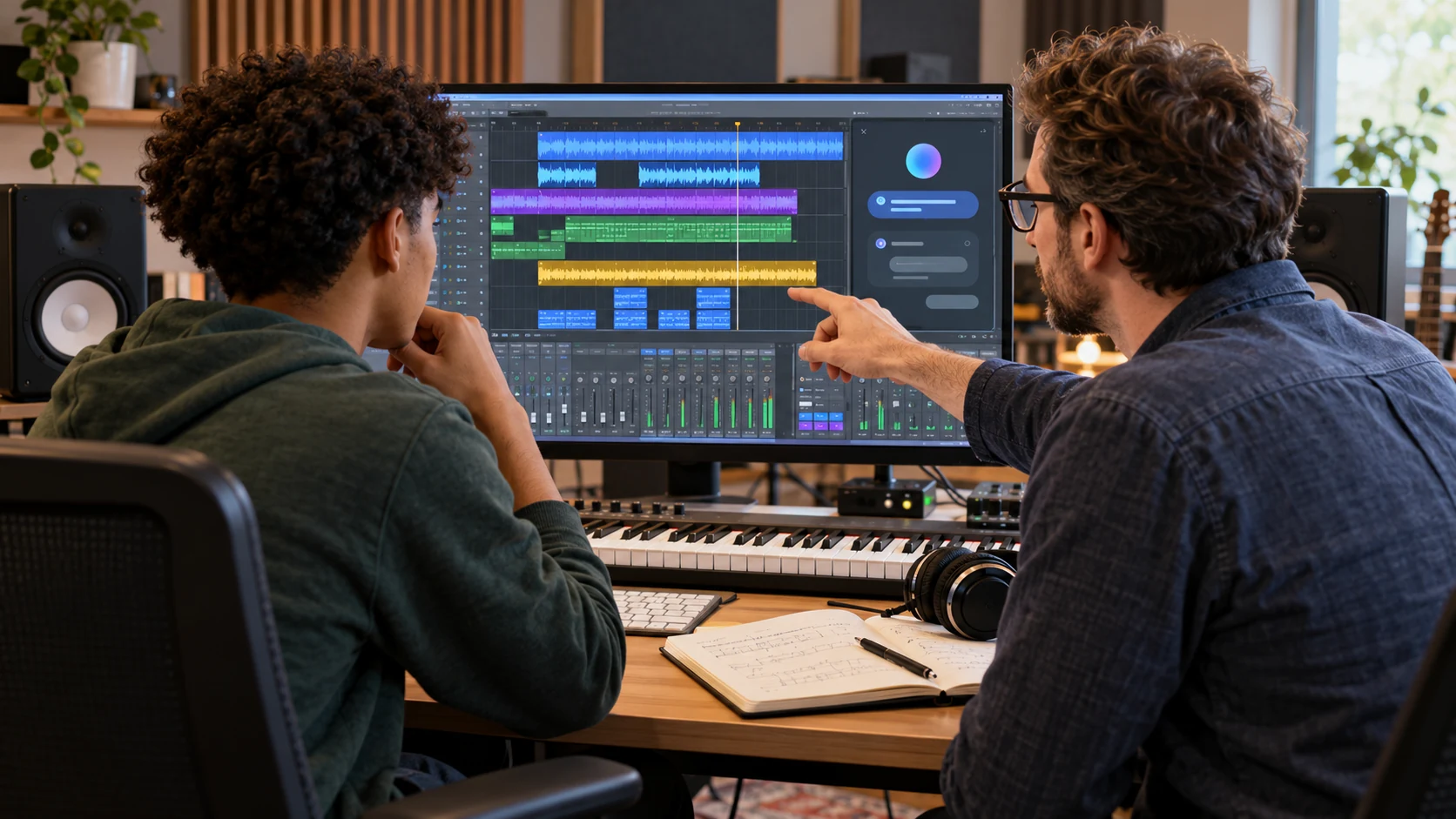
Apple’s forthcoming Logic Pro update could have implications far beyond faster music production. By introducing a conversational AI assistant directly into a digital audio workstation, Apple is raising important questions about how we teach, practise and assess music technology.
What has Apple announced?
On 27 October 2026, Apple announced new features for Logic Pro as part of an update to Apple Creator Studio, expected in November. Among them is an intelligent assistant for Logic Pro on Mac, designed to help users navigate production workflows, begin projects, set up tracks and refine existing sessions through natural-language requests.
The update also includes a redesigned sound Browser that uses on-device audio analysis to classify and tag sounds, alongside improvements to Stem Splitter that enable greater control over individual drum elements without access to the original multitrack recordings.
These are useful developments in their own right. However, conversational interaction with a professional DAW may be the more consequential change, particularly for music technology education.
From operating software to directing a workflow
Until now, learning a DAW has involved understanding its interface, signal flow, editing tools and underlying production concepts. Students have needed to know how to create tracks, establish routing, use processors and troubleshoot sessions themselves.
An integrated assistant changes the relationship between the user and the software. If a student can describe a desired result and have the software help carry out some of the steps, learning may become less about remembering commands and more about understanding what those commands achieve.
That could make music production more accessible and reduce the time spent on repetitive setup. But there is a potential downside: a student may produce a technically convincing result without fully understanding the processes involved. An AI assistant completing a routing task is not evidence that the student understands buses, sends, signal flow or gain staging.
Implications for A Level Music Technology
For A Level Music Technology, this development raises immediate questions about the balance between practical skills and conceptual understanding. Students must develop critical listening, recording, production and technology-based composition skills, not simply produce a satisfactory end result.
AI-assisted workflows could become useful teaching tools. For example, a teacher might ask students to construct a signal path manually, use an assistant to propose an alternative and then explain any differences. In mixing lessons, students could compare the assistant’s suggestions with their own decisions and justify the settings they choose.
However, classroom exploration and assessed coursework must be distinguished. Pearson Edexcel A Level Music Technology includes non-examined assessment in recording and technology-based composition, and current awarding-body and JCQ requirements on authentic student work remain essential. Teachers should check the applicable specification and guidance before permitting any AI-assisted action in assessed work; the fact that a feature is built into Logic Pro does not automatically make its use permissible.
A particularly useful teaching question might be: Can the student explain the processing and routing decisions even when the software has helped to implement them? That tests knowledge rather than simply speed of operation.
What changes for music production degrees?
At undergraduate level, the implications extend into production practice, sound design, mixing, mastering and professional workflow. Students need both technical independence and the ability to evaluate emerging tools critically.
AI assistance could support increasingly complex sessions, helping students explore alternative workflows or overcome interface-related barriers. Yet universities should be careful not to mistake efficient software operation for professional competence. A graduate still needs to diagnose problems, evaluate sonic outcomes, work across different DAWs and take responsibility for the final work.
Assessment methods may therefore need to place greater emphasis on documented decision-making, practical demonstrations, project-file inspection, reflective commentary and the ability to explain or reproduce techniques without assistance. This does not necessarily mean excluding AI. It means distinguishing between the student’s creative and technical contribution and actions delegated to software.
There is also a useful opportunity for comparative teaching: complete a production task manually, repeat it with permitted AI support and evaluate differences in time, accuracy, understanding and musical quality. Such exercises could develop AI literacy without allowing it to replace foundational skills.
A new digital divide in teaching studios?
Apple’s hardware and operating-system requirements matter to educational institutions. The wider Logic Pro update requires macOS 26.1 or later on an Apple silicon Mac. The assistant is more restrictive: its initial beta requires macOS 27 Golden Gate or later, an Apple Intelligence-capable Mac and US English.
Schools, colleges and universities may not be able to upgrade every teaching workstation immediately. Compatibility with audio interfaces, plug-ins, control surfaces and existing teaching infrastructure must also be considered. Departments should avoid building essential learning activities around a beta feature that is unavailable to some students or incompatible with established studio systems.
The skills that matter more, not less
Some skills may become even more important as AI becomes integrated into creative software: critical listening, understanding signal flow, knowing how dynamics and equalisation work, recognising errors, making artistic judgements and communicating clearly about a production.
Students may also need to learn how to formulate precise instructions, audit an assistant’s actions, preserve session versions and recognise when an automated suggestion is inappropriate. In professional audio, reliability and accountability matter as much as convenience.
An opportunity to rethink how we teach
I see potential value in an assistant that can reduce routine navigation and support experimentation. But I would be concerned if students came to rely on conversational commands before developing a practical understanding of the DAW and the audio processes it controls.
The educational challenge is not simply deciding whether AI should be allowed. It is deciding which skills students must demonstrate independently, where assistance genuinely deepens learning, and how to assess authentic achievement fairly.
For music technology teachers and university lecturers: should AI-assisted DAW operation become a taught professional skill, and which production tasks should students still be required to perform unaided?
Sources and further reading
- Apple Newsroom: Apple Creator Studio updates (27 October 2026)
- JCQ: Non-examination assessments and authenticity
- Pearson: Music Technology non-examined assessment guidance
Discover more from AV On the Edge Education
Subscribe to get the latest posts sent to your email.

