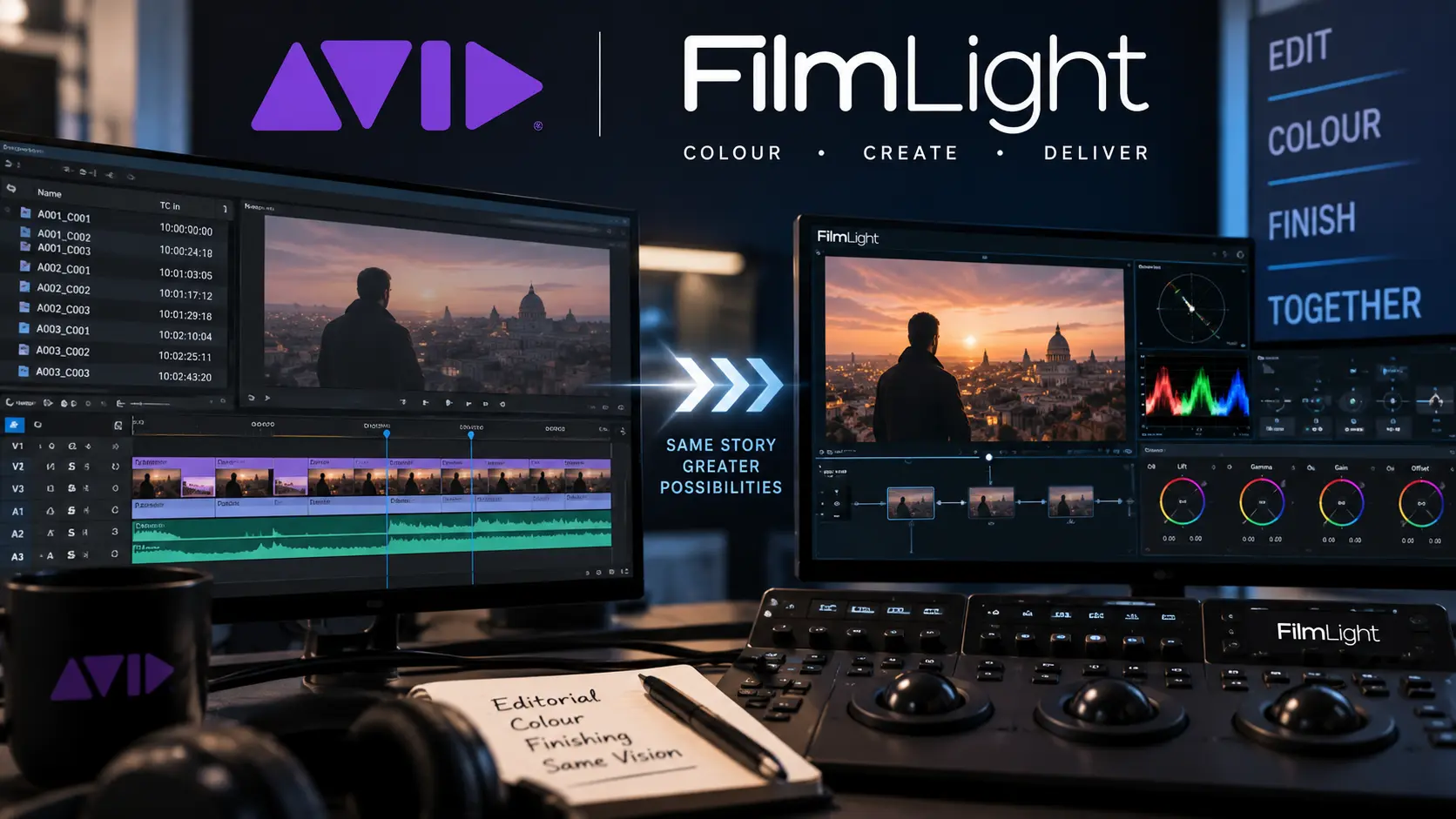
Avid and FilmLight have announced a strategic partnership intended to bring Baselight-powered colour tools more deeply into Media Composer and make colour decisions travel more cleanly from editorial into finishing.
At first glance, this is a picture-post story rather than an audio one. But the underlying problem will be immediately familiar to anyone who has received a turnover for sound: specialist departments need different tools, while the information connecting those tools is often fragile.
Beyond a plug-in workflow
Avid says the partnership is intended to go beyond the existing plug-in model. The companies are working towards a workflow in which colour decisions made during editorial can move into Baselight finishing more seamlessly, using metadata and reducing unnecessary rendering.
The attraction is straightforward. An editor can make creative colour decisions while cutting without those choices becoming a flattened dead end when the project reaches the colourist.
Instead, the decision can remain meaningful data that the specialist finishing system understands.
The same problem exists throughout post-production
Film and television post is built around handovers. Picture editorial passes material to VFX, sound and colour. Those departments return new versions. Mastering and delivery then combine the finished elements into programme assets.
Every handover creates opportunities for information to disappear. Clip names change, metadata is stripped, effects are rendered, versions diverge or somebody has to reconstruct a decision that existed perfectly well in the previous application.
The conventional answer has often been to improve interchange formats. The Avid-FilmLight announcement points towards a complementary idea: preserve more of the creative intent itself as persistent metadata.
Why sound should pay attention
Audio post has made enormous progress in interchange, but turnovers are still a common source of friction. AAFs can arrive with missing handles, confusing clip naming, unexpected processing or incomplete metadata. Picture changes can require reconforming. Guide tracks, production sound metadata and editorial intent do not always survive in the form the sound department needs.
For Pro Tools users, the ideal future is not necessarily to make Media Composer perform sound post or Pro Tools perform picture finishing. Specialisation is valuable.
The more useful goal is to make the boundary between those specialist applications less destructive.
Renderless handovers are a useful principle
Rendering is sometimes essential, but it can also turn an editable decision into a fixed asset. Once a process has been flattened, the receiving department may know what the previous department produced without knowing how or why it was produced.
Metadata-led workflows can preserve more flexibility. A colourist can inherit an editorial colour decision as information rather than merely as pixels. The equivalent idea in sound would be for editorial decisions, source relationships, clip effects and production metadata to survive more reliably into the audio session.
Post-production does not need one application to do everything
There is a recurring temptation in software development to solve workflow problems by adding more disciplines to a single application. But high-end post-production remains specialised for good reasons.
Colourists, sound editors, mixers, VFX artists and editors need interfaces and tools optimised for different kinds of work. A better future may therefore be one in which applications remain specialised while projects become more interoperable.
That would allow departments to retain depth without treating every turnover as a translation exercise.
The bigger opportunity for Avid
Avid occupies a particularly important position because Media Composer and Pro Tools sit on opposite sides of one of the most common professional handovers in screen post-production.
The FilmLight partnership demonstrates a willingness to think about continuity of creative information between editorial and finishing. Applying the same philosophy even more aggressively between Media Composer and Pro Tools could have direct benefits for sound teams: richer metadata, fewer flattened decisions, more reliable source relationships and less time spent diagnosing turnovers.
The colour pipeline may be where this development begins, but the underlying principle belongs to the whole post-production chain.
Discover more from AV On the Edge Education
Subscribe to get the latest posts sent to your email.

