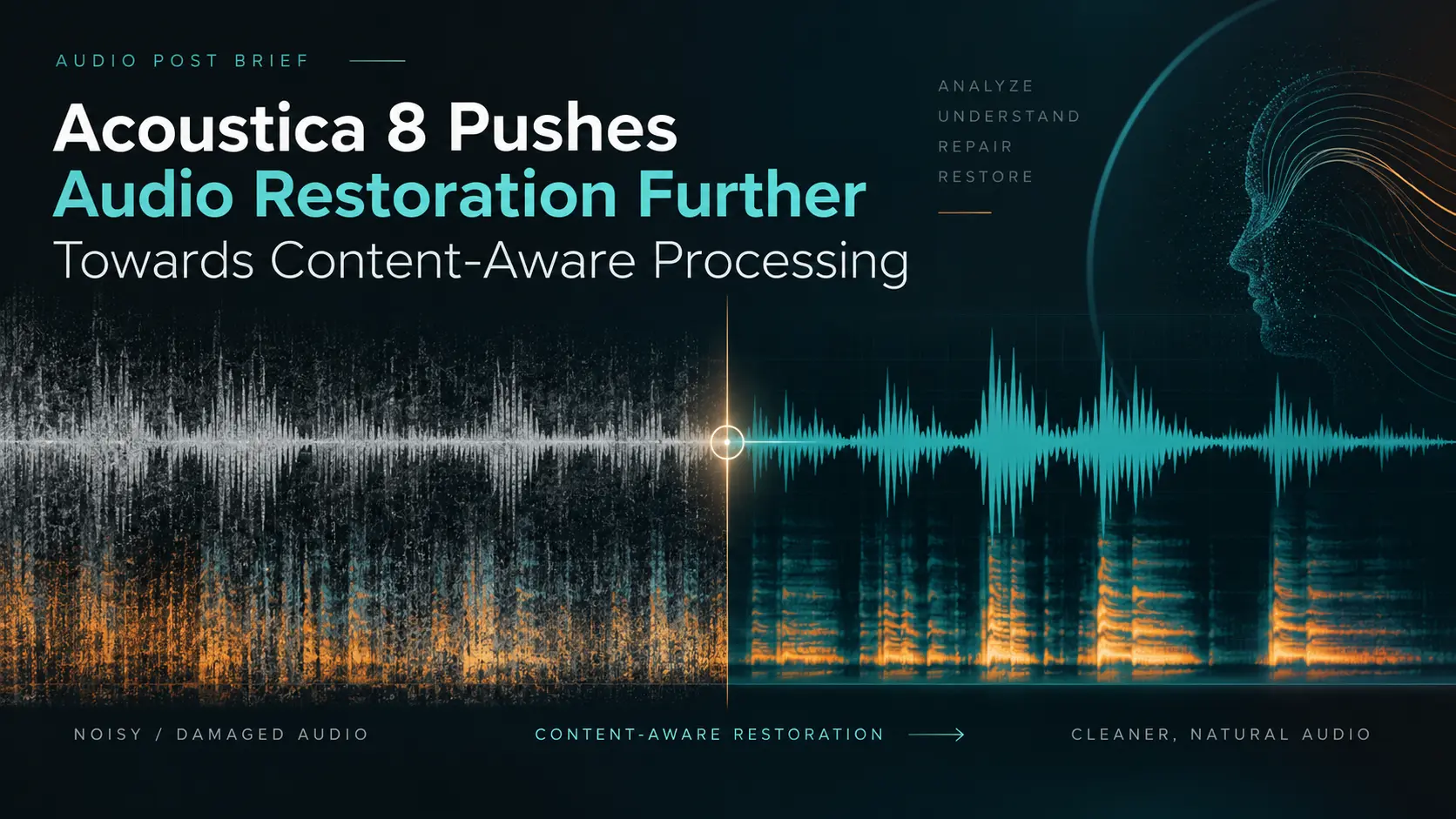
Acon Digital has released Acoustica 8, a substantial update to its audio editing and restoration platform that reflects a wider change in the way professional repair tools are being designed.
The headline is not simply that the processors are more powerful. DeNoise 3 and DeHum 3 now use machine-learning models and no longer depend on the engineer first capturing a conventional noise profile. Extract:Dialogue 2 adds separate control over voice, noise and reverberation, while the spectral editor gains new tools for finding related noise and reconstructing damaged material.
From noise profiles to content analysis
Traditional broadband noise reduction asks the engineer to identify a representative section of unwanted noise. The processor learns that profile and attempts to reduce matching energy elsewhere. It remains a useful method, but it assumes that a clean noise-only sample exists and that the unwanted sound is reasonably consistent.
Content-aware processing approaches the problem differently. Rather than relying entirely on a captured fingerprint, the software attempts to distinguish classes of material such as voice, noise, hum and reverberation.
That can be particularly valuable in production sound, documentary recordings and archive material where there may be no clean section from which to learn the noise.
Extract:Dialogue 2 is particularly relevant to post
Separating speech from its surroundings has become one of the most competitive areas in restoration software. Acoustica 8’s Extract:Dialogue 2 provides controls for voice, noise and reverberation, allowing the operator to rebalance those components rather than treating restoration as a single on/off process.
That distinction matters. A completely dry, aggressively isolated voice may measure as cleaner while sounding less believable in a scene. Dialogue editing often depends on retaining enough acoustic information for speech to remain connected to the location.
Spectral editing is becoming more intelligent
Acoustica 8 can identify spectral regions similar to a selected noise, potentially reducing the repetitive work involved in finding related unwanted events. AudioFill is intended to reconstruct larger damaged regions using surrounding audio.
These are the kinds of features that can make a significant difference when repairing intermittent interference, handling damaged archive recordings or rebuilding a short section that cannot simply be replaced with room tone.
They also reinforce an important point: automation does not remove the need for judgement. The faster a tool can generate a plausible repair, the more important it becomes to decide whether that repair is perceptually convincing.
Pro Tools and immersive workflows
Acoustica 8 includes ARA2 integration across the range and a dedicated transfer workflow for Pro Tools. For post-production users, integration can be almost as important as processing quality because restoration is rarely performed in isolation from the edit.
The Ultimate edition also supports immersive audio up to 9.1.6. That broadens Acoustica’s relevance beyond mono and stereo repair and acknowledges the increasingly multichannel nature of professional post-production delivery.
A serious alternative in a crowded restoration market
iZotope RX remains deeply established in post-production, but the professional restoration market is no longer defined by a single approach. CEDAR, Steinberg SpectraLayers, Accentize and Acon Digital are all developing tools that combine spectral editing, source separation and machine learning in different ways.
For engineers, that competition is useful. The question is becoming less about which application has the longest feature list and more about which tool produces the most natural result on a particular problem with the least friction.
The engineer still decides what sounds believable
Machine learning can remove steps from the process and make previously impractical repairs possible. It cannot decide how much background belongs in a scene, whether a voice has become unnaturally detached from its environment or whether a technically cleaner result is dramatically worse.
Acoustica 8 therefore points towards a future in which restoration becomes faster and more content-aware, while the value of critical listening becomes greater rather than smaller.
Source: Acon Digital, “Acoustica 8 Available Now – Our Biggest Release So Far!”.
Discover more from AV On the Edge Education
Subscribe to get the latest posts sent to your email.

