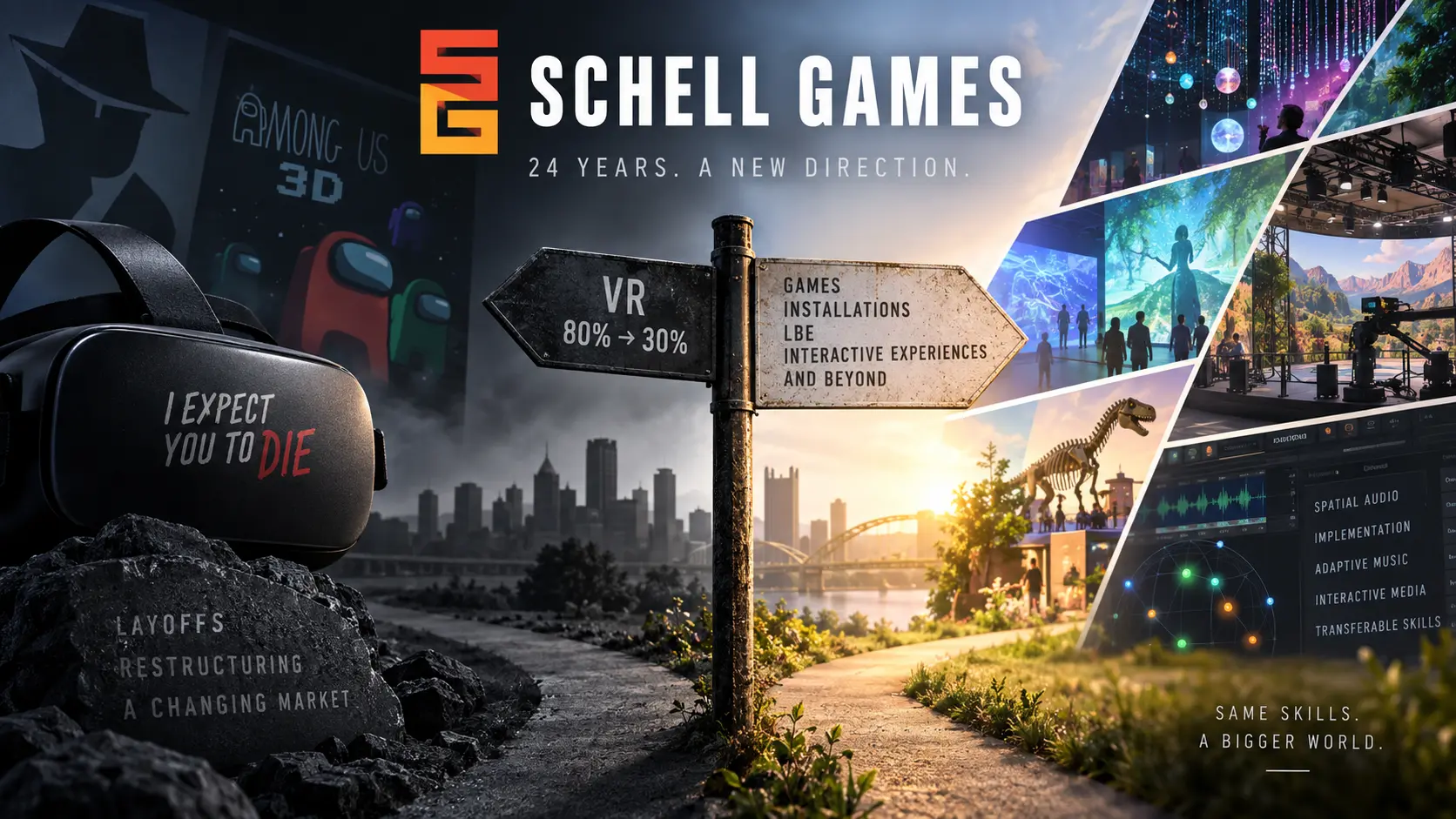
Schell Games has spent much of its 24-year history doing something increasingly unusual in the games industry: avoiding layoffs.
That changed on 21 August 2026, when the Pittsburgh-based studio, best known for the I Expect You To Die series and its work on Among Us 3D, made the first redundancies in its history.
CEO and founder Jesse Schell subsequently confirmed that approximately 10% of the workforce had been cut, leaving around 125 employees. The more important part of his statement, however, may be what came next. Schell Games is changing both the scale of the projects it takes on and the markets in which it expects to work.
For game-audio professionals, that raises a wider question. If a studio strongly associated with VR is diversifying away from headset-based projects, does that signal a shrinking specialist market, or the beginning of a broader one?
The first layoffs in Schell Games’ history
The cuts were first made public through employee posts and were subsequently reported by outlets including Game Developer. On 24 August, Jesse Schell confirmed the scale of the restructuring in a statement to Good Virtual Reality.
He said the company had found it necessary to reduce its workforce by around 10% for what he described as “rebalancing purposes”. After the cuts, Schell Games had approximately 125 staff.
The significance goes beyond the number of jobs lost. Schell has spoken publicly in the past about deliberately structuring the company to avoid putting jobs at risk. That makes the decision a particularly striking indicator of how difficult the current games market has become, even for experienced and diversified independent studios.
The redundancies reportedly affected several disciplines, including marketing, art, design and visual effects. There has not been a public indication that game-audio roles were specifically targeted, but the strategic changes behind the cuts are highly relevant to anyone working in interactive sound.
From fewer large projects to more smaller projects
Schell explained that the company had been moving towards a smaller number of larger titles. It now believes that a greater number of smaller projects offers a more sustainable model in the present market.
That is an important shift because the size and structure of a project influence how specialist teams are built.
A large game may justify dedicated in-house roles for sound design, technical sound design, audio programming, dialogue, music implementation and spatial audio. Smaller projects may still require many of those capabilities, but not necessarily as separate permanent jobs.
That can increase demand for practitioners who can cross traditional role boundaries. A sound designer who can also implement assets in Wwise, FMOD or Unreal, build interactive systems, troubleshoot integration problems and deliver finished mixes may be more useful to a small multidisciplinary team than somebody working in a very narrow production role.
It can also increase the role of external specialists. Smaller project teams may bring in freelance composers, dialogue editors, Foley artists, technical sound designers or implementation specialists for specific phases rather than maintaining every discipline internally.
This does not automatically make employment more secure. Freelance and project-based work transfers more risk to the individual practitioner. It does, however, change where game-audio work may be found.
VR has fallen from around 80% to 30% of Schell Games’ work
The most revealing figure in Schell’s statement concerns VR itself.
He said there was a period when headset-based VR represented around 80% of Schell Games’ work. Today, it is closer to 30%.
The studio has not abandoned VR. Schell said it still has a new VR title in production and proposals in place for others. But the company is increasingly working in what he described as VR-adjacent areas, including interactive projection and location-based entertainment.
For audio, this distinction matters.
VR encouraged many practitioners to develop highly specific skills around spatial localisation, head tracking, binaural rendering, environmental acoustics, interactive ambience and sound that responds continuously to player movement.
Those skills are not exclusive to headsets.
Spatial-audio skills can travel beyond conventional VR
Location-based entertainment, interactive installations and projection-led experiences can all require sophisticated relationships between sound, space and audience movement.
In some cases, the technical approach will be different from consumer VR. A headset may rely primarily on headphones and head-related transfer functions, while an installation could use multichannel loudspeaker arrays, tracked objects, room-based playback, interactive zones or combinations of physical and virtual sound sources.
But many of the underlying design questions remain familiar:
- Where should a sound appear to originate?
- How should it change as the listener moves?
- How do we guide attention without relying on a fixed camera?
- How should ambience respond to zones, proximity or interaction?
- How do we maintain intelligibility in a complex physical environment?
- How do we create convincing transitions between real and virtual space?
This suggests that spatial-audio knowledge may increasingly function as a transferable interactive-media skill rather than a narrowly defined VR specialism.
That is consistent with a broader change already visible across games, immersive media, virtual production, museums, exhibitions and location-based experiences. The technologies differ, but the ability to design sound for non-linear spaces is becoming useful across more than one sector.
Game audio may be becoming part of a wider interactive-audio market
The phrase “game audio” can sometimes hide how transferable the discipline has become.
A practitioner who understands events, states, parameters, triggers, real-time mixing, spatial behaviour and user interaction already has a toolkit that can apply outside a traditional game.
Consider the overlap with:
- location-based entertainment;
- immersive theatre;
- museum and gallery installations;
- interactive projection;
- theme-park and visitor attractions;
- mixed-reality experiences;
- virtual production;
- training and simulation;
- interactive branded experiences.
These markets are not necessarily large enough to compensate for every lost role in conventional game development, and it would be a mistake to treat diversification as evidence that the employment problem has disappeared.
What they may offer is a wider definition of where an interactive-audio career can exist.
What this means for early-career game-audio professionals
For students and people entering the industry, the lesson is not that VR is over or that everybody should immediately move into installations.
The more useful conclusion is that specialist skills become more resilient when they can travel.
A strong game-audio portfolio should still demonstrate creative ability, but it increasingly helps to show how sound behaves inside a system rather than presenting only linear redesigns.
Useful evidence might include:
- interactive ambience driven by location or game state;
- spatial sound responding to listener movement;
- adaptive music controlled through parameters;
- procedural or randomised sound systems;
- dynamic mixing and prioritisation;
- implementation in Wwise, FMOD, Unity or Unreal Engine;
- documentation showing how the system works;
- examples demonstrating how the same skills could apply to games, XR or physical interactive experiences.
Technical fluency is particularly valuable here. Someone who can design sound and understand implementation is better placed to move between disciplines and production models.
I explored this broader approach in How to Build a Resilient Career in Game Audio, where the emphasis is on combining a clear specialism with middleware, implementation and transferable production skills.
What this means for educators
The Schell Games restructuring also raises questions for game-audio education.
If interactive-audio careers increasingly cross games, XR, installations and location-based entertainment, courses may need to avoid teaching middleware and spatial sound only within one narrow professional context.
Students should understand the transferable principles behind the tools they use.
For example, a lesson on attenuation is not only about placing a sound source in a game engine. It is about how distance changes perception. A lesson on states and parameters is not only about Wwise terminology. It is about designing systems that respond to changing conditions. A lesson on binaural audio is not only about VR headsets. It can become a starting point for understanding spatial perception across immersive formats.
Educators can also create briefs that move between contexts. A student might first build an interactive soundscape in a game engine and then redesign the same concept for a gallery installation, projection environment or location-based experience.
That kind of work encourages students to think in terms of transferable systems rather than individual software packages.
A warning against reading too much into one studio
Schell Games is one company, and its restructuring should not be treated as a complete description of the VR or games market.
The studio still has VR work in production, and its decision to diversify reflects its own commercial circumstances, project pipeline and strategy.
There is also a risk of presenting adjacent sectors as an easy escape route from games-industry instability. Location-based entertainment and immersive installations have their own budgets, commissioning cycles and employment pressures.
Nevertheless, Schell’s figures are significant because they show how dramatically the balance of work can change inside a studio strongly associated with VR.
If headset-based VR can move from around 80% to 30% of a company’s work while spatial and interactive skills remain useful elsewhere, the important career question may no longer be “Do I work in VR?”
It may be: “What kinds of interactive experiences can my audio skills support?”
Is the market broadening, or simply contracting?
The first layoffs in Schell Games’ history are clearly bad news for the people affected, and they add to a much wider period of instability across the games sector.
But the strategic shift behind them deserves attention too.
A move from a few larger projects towards more smaller projects can change how specialist audio talent is hired. A decline in headset-focused work can push spatial and interactive skills into adjacent formats. Location-based entertainment, interactive projection and other immersive experiences may become increasingly relevant to people who previously thought of themselves exclusively as game or VR audio professionals.
That does not necessarily mean there are more jobs overall. It may mean that the boundaries around those jobs are becoming less clear.
I’d be interested to hear from people working in game and interactive audio: are you seeing the employment market broaden beyond traditional games, or simply contract?
Sources and further reading
- Good Virtual Reality: Schell Games Reduces Workforce 10 Percent
- Game Developer: Report: Among Us 3D co-dev Schell Games lays off staff
- UploadVR: Among Us 3D Developer Schell Games Confirms Layoffs
Discover more from AV On the Edge Education
Subscribe to get the latest posts sent to your email.

