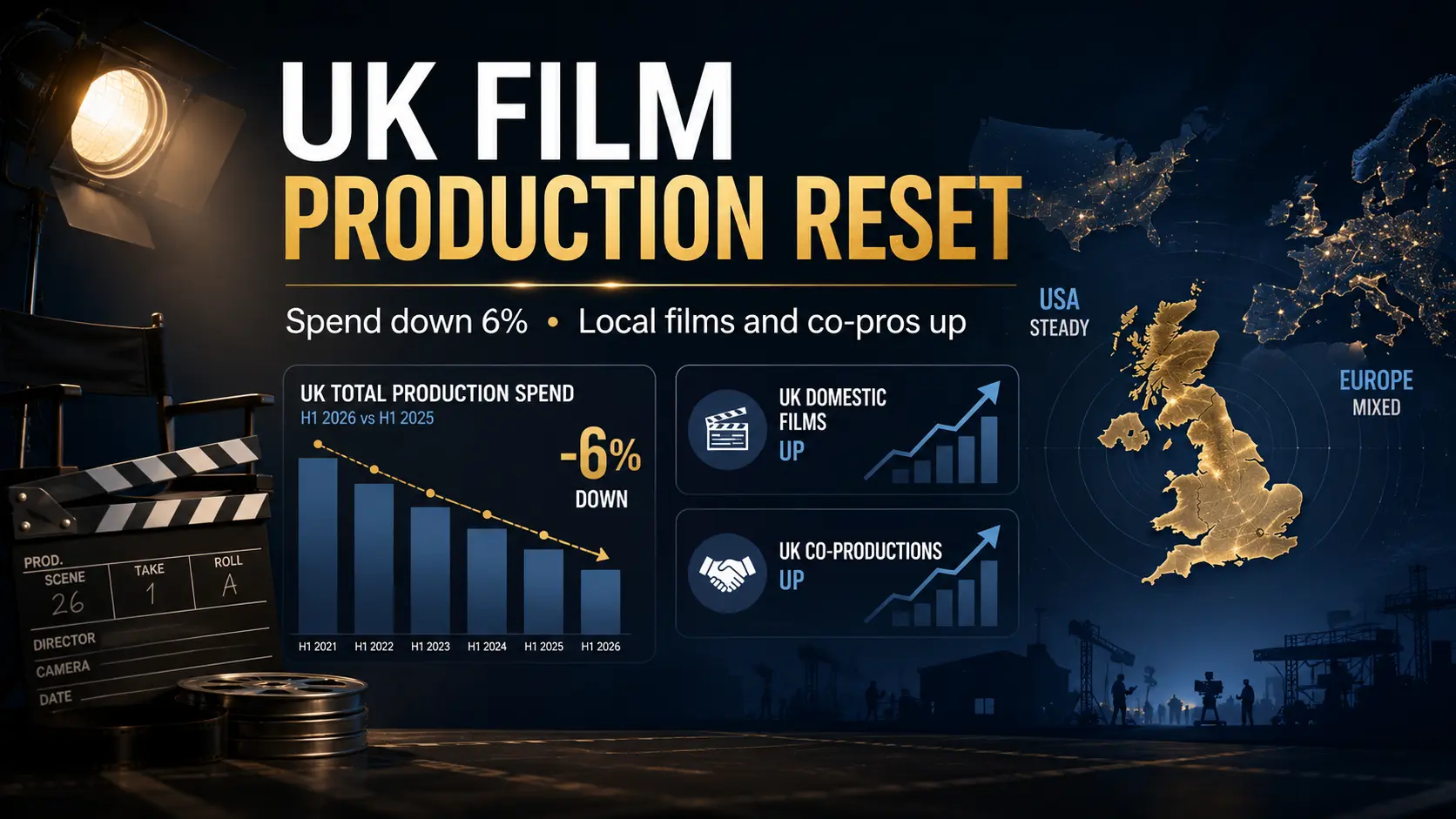
UK feature film production spending fell by 6% in the first half of 2026. At first glance, that sounds like another warning sign for a screen sector still dealing with the after-effects of strikes, streaming retrenchment, rising costs and uncertainty around commissioning.
But the headline number hides a more complicated — and arguably more important — shift. The decline is being driven principally by lower spending on inward-investment films, while domestic UK films and international co-productions are moving in the opposite direction. In other words, the UK may not simply be experiencing a production downturn. It may be seeing a change in the type, scale and financing structure of the films being made here.
That becomes clearer when the UK figures are viewed alongside what is happening in Hollywood and continental Europe.
The headline figure needs context
Screen Daily, reporting the latest BFI figures, notes that total UK feature production spend was 6% lower in January–June 2026 than in the equivalent period of 2025. The comparison matters because the first half of 2025 itself was already slightly softer than 2024: £1.09bn was spent on 66 films beginning principal photography in H1 2025, 1% below the £1.11bn first reported for H1 2024.
| UK feature production | H1 2024 | H1 2025 | H1 2026 |
|---|---|---|---|
| Total spend | £1.11bn* | £1.09bn | Approximately £1.03bn** |
| Year-on-year change | — | -1% | -6% |
| Main source of spend | Inward investment | Inward investment: £999m / 91% | Inward investment remains dominant but lower |
The direction is therefore downward, but not dramatically so. It is also important to remember how volatile six-month production-spend figures can be. A handful of £150m–£250m studio films beginning principal photography in one quarter rather than another can move the total substantially.
The BFI itself repeatedly cautions that production data is revised upwards as more information is received, particularly for smaller domestic films. The organisation’s 2025 full-year data illustrates the problem with interpreting short periods too strongly: feature film spend eventually reached a record £2.77bn, up 31% on the first-reported 2024 figure, even though the first half of 2025 had appeared essentially flat.
The real change is the budget mix
The most revealing part of the 2026 figures is therefore not simply the 6% fall. It is where activity is strengthening and weakening.
In the first quarter alone, UK film production spend was £563m, 11% below the equivalent 2025 period. Yet spending on local UK productions jumped 69%, from £26m to £44m. Co-production spending also rose, from £13.6m to £18m. The weakness came from inward investment, which fell from £592m across 15 films in Q1 2025 to £501m across 12 films in Q1 2026.
| UK film production, Q1 | 2025 | 2026 | Change |
|---|---|---|---|
| Overall spend | £632m | £563m | -11% |
| Inward-investment spend | £592m | £501m | -15% |
| Domestic UK spend | £26m | £44m | +69% |
| Co-production spend | £13.6m | £18m | +32% approximately |
This suggests that fewer very large productions — or simply a less expensive group of them — can explain much of the fall. That is quite different from saying fewer films are being developed or that the UK is suddenly becoming unattractive as a production base.
Why might the biggest films be spending less?
1. Hollywood is still reducing production volume
The most important external factor is probably the continuing reset in the American studio and streaming businesses.
The streaming boom encouraged studios and technology companies to commission at a pace that increasingly proved difficult to sustain. Investors subsequently demanded profitability rather than subscriber growth at almost any cost. Scripted commissions fell, projects were cancelled, development slates were reduced and expensive productions came under greater scrutiny.
UK workforce data reflects the consequences. A 2026 ScreenSkills/Ampere Analysis study found that the volume of UK-produced film and television titles released declined 13% between 2022 and 2025. Scripted commissioning fell 15% and SVoD commissions fell 25%. ScreenSkills estimated that the production workforce was operating at only around 50–55% capacity during 2025.
That means the UK can remain one of the world’s most competitive production centres while still receiving fewer commissions from the companies that provide most of its inward investment.
2. The post-strike rebound created unusually strong comparisons
The 2023 WGA and SAG-AFTRA strikes interrupted major US-backed productions around the world. Their resolution created a restart effect through 2024 and 2025 as delayed projects returned to stages and locations.
The BFI attributed much of the 2024 recovery in inward-investment film spending to Hollywood productions restarting after the strikes. That makes 2025 a difficult comparison year. Some of the apparent 2026 decline may therefore represent normalisation after a backlog rather than the start of a new collapse.
3. Studios are becoming more selective about very high budgets
Production economics have become harder to justify. Cinema attendance remains below pre-pandemic levels in many markets, while streaming platforms have become more disciplined about content expenditure. The BFI reported that UK cinema admissions in 2025 were still 30% below 2019, despite a modest improvement in box-office revenue.
Europe shows the same tension. The European Audiovisual Observatory reported that cinema admissions in Europe in 2025 remained 26% below the pre-pandemic average, even as more films were being released. That makes the financial case for increasingly expensive films more difficult, particularly outside established franchises.
4. Production incentives are creating a genuine global bidding market
The UK is not competing only with Hollywood. It now competes with dozens of territories offering increasingly sophisticated tax incentives, rebates, infrastructure and trained crews.
A major 2026 European Audiovisual Observatory study identified more than 120 automatic audiovisual production incentive schemes worldwide. Its central conclusion is significant: incentives are no longer supplementary support. They are structural tools determining where films and television programmes are financed and made.
Germany, for example, increased the combined 2026 budgets of its German Motion Picture Fund and German Federal Film Fund to €250m, with grants of up to 30% of eligible costs. Malta has developed an especially aggressive model, with rebates that can reach 40%. Spain, Hungary, Ireland, France and numerous regional European funds are competing for the same internationally mobile productions.
The implication is that the UK’s strong infrastructure and crew base are still major advantages, but they no longer guarantee that every large production will automatically choose Britain.
Why are UK independent films moving in the opposite direction?
The improvement in domestic production is particularly interesting because financing UK independent films has been one of the industry’s long-running weaknesses.
One plausible contributor is the Independent Film Tax Credit (IFTC), which became available from April 2025 for qualifying films with budgets up to £15m. The enhanced relief is intended to make lower and mid-budget British films more financeable and help producers retain greater value in their projects.
It would be too early to attribute the entire rise in domestic spending to the IFTC — particularly because financing remains difficult and producers have raised concerns about the cost of borrowing against the credit. But the timing of the improvement makes it reasonable to see the policy as part of the explanation.
There is also a strategic reason to encourage this part of the market. A production economy dominated by a small number of giant inward-investment projects can generate enormous spending while still leaving freelancers vulnerable when one studio slate moves elsewhere. A larger base of domestic films and co-productions spreads activity across more producers and potentially creates a more resilient production ecology.
The US comparison: Britain is partly benefiting from Hollywood’s problem
The situation in Los Angeles provides a useful counterpoint. Greater LA on-location production totalled 5,121 shoot days in Q1 2026. That was up 10.7% on the previous quarter but still 3.3% below Q1 2025. Feature films were a rare bright spot, rising 52.3% year on year.
The second quarter weakened again: FilmLA recorded 4,711 shoot days, approximately 12% below Q2 2025 and roughly 36% below its five-year average.
California’s response is striking. Its expanded Film & Television Tax Credit programme awarded 170 projects in the year to June 2026, representing an anticipated $6.6bn in direct California production spending and almost 35,000 cast and crew jobs.
| Market | Current production signal | Policy response / competitive position |
|---|---|---|
| UK | H1 2026 feature spend down 6%; domestic and co-production activity stronger | Long-established tax reliefs, enhanced independent-film credit, major studio infrastructure and crews |
| Los Angeles / California | Q2 2026 on-location shoot days down about 12% year on year and 36% below five-year average | Expanded California incentive; projects approved in 2025/26 represent $6.6bn of projected direct spend |
| Europe | Record 2,523 feature films produced across 36 markets in 2024, while cinema demand remains below pre-pandemic norms | Dense network of national and regional rebates, credits, public funds and co-production structures |
This is the paradox at the centre of the current production market. American studios may be making fewer programmes and films overall, but the projects they do make are being competed for more aggressively by California, other US states, the UK, Canada, Australia and Europe.
The UK is therefore both exposed to Hollywood contraction and one of the beneficiaries of production moving away from Hollywood.
Europe: more films, but not necessarily an easier business
Continental Europe looks stronger if measured by production volume. The European Audiovisual Observatory says 2,523 feature films were produced across 36 European markets in 2024 — a record.
That does not mean European producers are enjoying a boom. Financing remains difficult, cinema admissions remain depressed and broadcasters face advertising and structural pressures. France, for example, entered 2026 with increasingly public concern about pressure on its traditional film-financing model, particularly for lower and mid-budget productions.
At the same time, global streamers have become increasingly important financiers of European content. The Observatory estimates that global streaming platforms provided 24% of spending on European original content in 2024, up from only 8% in 2020.
This creates another important comparison with Britain. European countries are increasingly using incentives, public funding and co-production treaties not simply to subsidise individual films, but to build production ecosystems capable of attracting global commissioning while sustaining local production.
What the comparison tells us
| Pressure | UK | US / Hollywood | Europe |
|---|---|---|---|
| Streaming commissioning reset | High exposure because inward investment dominates spend | Origin of much of the studio/platform retrenchment | Increasing streamer financing, but slower growth |
| Tax-incentive competition | Strong established offer | California expanding incentives; states also compete internally | Very strong and increasingly sophisticated |
| Domestic film resilience | Improving from a comparatively small base | Large industry but production geographically dispersed | High production volume, often supported by public finance |
| Dependence on large international productions | Very high in spend terms | Studios are domestic but shoots are globally mobile | Varies greatly by country |
| Key current risk | Fewer major projects create large swings in work and spend | Runaway production and high production costs | Fragmented financing, weaker admissions and public-budget pressure |
The employment problem may be more important than the headline spend
For freelancers, facilities and post-production businesses, aggregate spending can be a misleading measure of industry health.
A year containing several £200m studio features can produce impressive headline expenditure while still providing fewer total weeks of work across the wider workforce than a market containing a larger number of mid-budget films and returning series. The ScreenSkills finding that the workforce operated at around 50–55% capacity during 2025 helps explain why record film spending and industry reports of unemployment could exist at the same time.
This matters particularly to sound, picture post, VFX, construction, costume and other specialist suppliers. A more diverse production base — domestic films, co-productions, HETV, international features and regional production — may ultimately be healthier than relying primarily on a small number of enormous projects.
So, is the UK losing ground?
Not on the evidence available so far.
The first-half fall is worth watching, particularly because inward-investment production still supplies the overwhelming majority of UK feature-film spending. If that category continues to decline through several reporting periods, it would become much more significant.
For now, however, the evidence points towards a more nuanced conclusion:
- global studios and streamers are commissioning more selectively;
- the post-strike production rebound is normalising;
- large productions are being competed for by more territories than ever;
- California is increasing incentives precisely because it has been losing production;
- European countries are treating fiscal incentives as industrial strategy;
- the UK remains highly competitive for inward investment but is vulnerable to changes in a relatively small number of very large projects; and
- the rise in domestic UK films and co-productions may be an early indication that policy designed to strengthen the lower-budget end of the sector is beginning to have an effect.
The most encouraging outcome would therefore not necessarily be a return to ever-higher headline spending driven by a few Hollywood blockbusters. A stronger long-term result would be a UK production economy that keeps those films while also supporting a larger, continuously active layer of British independent films, international co-productions and returning television.
The next BFI production release, covering January to September 2026, is scheduled for 10 November. That should make it much easier to judge whether the first-half decline was chiefly a matter of production timing and budget mix — or the beginning of a more persistent change.
Sources and further reading
- Screen Daily: Total UK feature production spend drops 6% in first half of 2026
- BFI: Official 2025 film and high-end television production statistics
- Screen Global Production: UK film production spend dips 11% in Q1 2026
- European Audiovisual Observatory: Fiscal incentives and cash rebates in the audiovisual sector
- European Audiovisual Observatory: Key Trends 2026
- FilmLA: 2026 Los Angeles production reports
- California Film Commission: Expanded Film & TV Tax Credit programme
Discover more from AV On the Edge Education
Subscribe to get the latest posts sent to your email.

