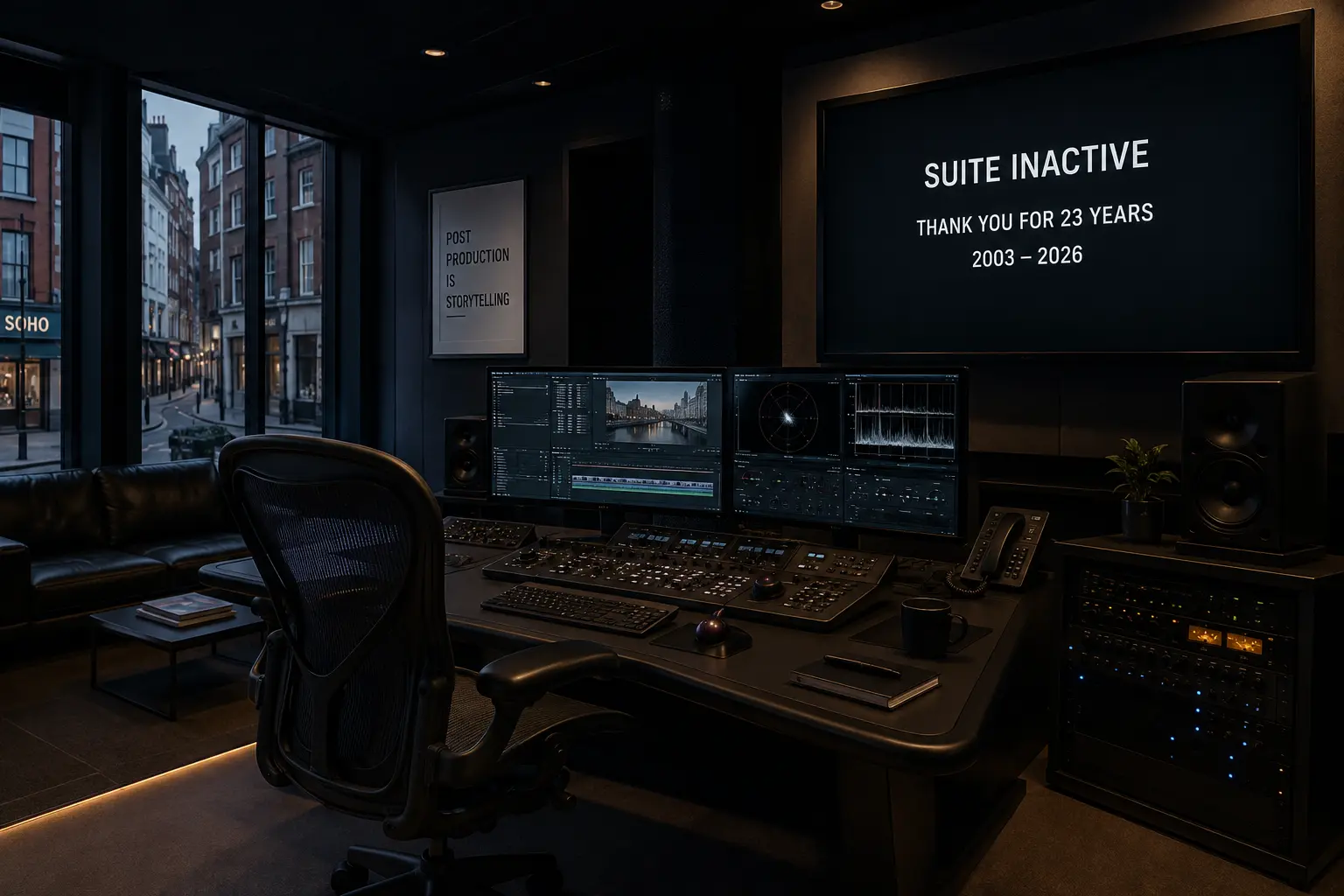
The closure of Fifty Fifty after 23 years is not simply another story about falling demand. The company says its facilities have been full. The more troubling issue is that being busy no longer guarantees that a post-production business is financially sustainable.
London post-production house Fifty Fifty has announced that it will cease trading on Friday 31 July 2026, bringing 23 years of operation to an end.
The closure is significant not only because of the company’s history, reputation and recent credits, but because of the circumstances surrounding it. According to founder Sally Pacy, Fifty Fifty had explored the realistic options available to keep operating. Its suites and staff had reportedly been fully occupied during the year, with further work expected in the autumn. Nevertheless, the income and margins were insufficient to sustain the business.
That distinction matters.
This is not a straightforward story about an empty facility that could no longer find clients. It is a warning that, within parts of the UK post-production sector, high utilisation and commercial viability have become dangerously disconnected.
A company can be busy, respected and delivering high-profile work while still failing to generate enough margin to maintain its staff, premises, technology and infrastructure. Fifty Fifty’s closure therefore raises a more difficult question than whether there is enough work in the market:
Is the work being commissioned, priced and delivered in a way that allows the companies doing it to survive?
A respected company operating in a difficult market
Founded in 2003, Fifty Fifty became an established part of London’s post-production community. The company provided services across editing, colour, audio and finishing, and was one of the relatively small number of post and VFX businesses to achieve B Corp certification.
Its recent clients reportedly included Mindhouse, Avalon, South Shore, Raw TV, Optomen and Dorothy Street Pictures. Recent credits included Louis Theroux: Inside the Manosphere, How to Get Filthy Rich with Gary Stevenson and How to Trick Your Way Onto the Property Ladder.
This makes the closure particularly uncomfortable. Fifty Fifty was neither an obscure operation nor a company evidently detached from current production. It had recognised clients, active projects, experienced staff and occupied facilities.
Yet that was not enough.
Fifty Fifty is also not an isolated case. The UK has recently seen the closure or administration of several recognised post-production businesses. Halo Post Production and Evolutions entered administration in December 2025. Absolute and its animation division Blind Pig ceased operating in 2026, while No.8 announced insolvency proceedings in June after citing economic pressures and significant changes in client behaviour. Formosa also closed its UK scripted audio post-production operation in late 2025.
Different businesses will, of course, have different financial structures, clients and reasons for closing. It would be wrong to treat every case as identical. Collectively, however, these closures indicate that the problem is broader than the performance of any one company.
The headline production figures conceal an uneven market
At first glance, the wider UK screen sector appears to be performing strongly.
Official BFI figures show that film and high-end television production expenditure reached £6.8 billion in 2025. High-end television accounted for approximately £4 billion, while feature-film production contributed £2.8 billion.
However, the distribution of that spending is as important as the total.
Approximately 85% of combined film and high-end television expenditure came from inward investment. The BFI also reported that the overall number of productions was lower than in recent years, despite the higher level of spending. In high-end television, 168 productions started principal photography in 2025, compared with 181 initially reported for 2024.
This creates a market in which a smaller number of very large productions can generate impressive national expenditure figures without necessarily providing consistent work across the entire production and post-production ecosystem.
Large inward-investment productions are valuable to the UK. They support employment, facilities, skills and international recognition. But headline expenditure concentrated in major films and premium television does not automatically replace the volume of documentaries, factual entertainment, entertainment programmes, commercials and lower-budget domestic productions on which many independent facilities have traditionally depended.
A country can therefore report record production spending while individual post houses, production companies and freelancers remain under severe pressure.
Domestic commissioning remains constrained
The challenges are especially visible in the parts of the industry most dependent on UK broadcasters and advertising.
Ofcom reports that linear television advertising revenue fell by 10% during 2025, from £3.13 billion to £2.81 billion. Public service broadcasters’ spending on first-run UK-originated programming also fell from £2.8 billion in 2024 to £2.6 billion in 2025. Although some of that reduction followed unusually high spending on major sporting events in 2024, Ofcom describes commissioning conditions as constrained, while originated programme volumes remain below pre-pandemic levels.
The longer-term audience shift is equally important. Broadcaster video-on-demand is growing, but live television viewing and the weekly reach of traditional broadcast television continue to decline. Younger audiences increasingly divide their attention between streaming services, social platforms and other forms of online video.
Broadcasters are therefore being asked to invest in distinctive UK programming while simultaneously managing falling linear audiences, changing advertising markets, platform development costs and competition from global technology companies.
Those pressures inevitably travel down the supply chain.
Production companies face tighter budgets. Post schedules become shorter. More deliverables, versions and platform specifications may be required. Facilities are expected to maintain high technical, security and service standards, but the amount available to pay for those services does not necessarily rise with the cost or complexity of delivering them.
Full capacity is not the same as profitability
The most important lesson from Fifty Fifty’s announcement may be that utilisation is an incomplete measure of health.
A suite that is booked for ten hours is not necessarily profitable for ten hours. A project can keep editors, mixers and colourists occupied while contributing too little towards the fixed costs of running the business.
Those costs can include:
- salaries, freelance fees and employer costs;
- central London property and business rates;
- equipment purchasing, leasing and maintenance;
- software subscriptions and support contracts;
- storage, archiving and data transfer;
- cybersecurity and content-protection requirements;
- insurance, power and environmental controls;
- production management, bookings and technical support;
- unpaid bidding, testing and client-development time;
- revisions, versioning and overruns that were not adequately included in the quotation.
The danger arises when a facility responds to difficult trading conditions by accepting more work at lower margins. That may improve room occupancy and headline turnover, but it can make the underlying problem worse. The company becomes busier without becoming stronger.
Once this pattern spreads through a market, sustainable pricing becomes harder for everyone. Facilities compete against rates that may not represent the real cost of delivery. Clients come to regard exceptional discounts or compressed schedules as normal. Suppliers then depend on volume to compensate for insufficient margin, leaving them vulnerable to even a small interruption in the commissioning cycle.
Consolidation and in-house post are changing the market
Independent facilities are also competing with a changing range of delivery models.
Large production groups increasingly have the scale to develop internal post-production capacity. Banijay UK, for example, expanded its B Post operation with more than 25 cutting rooms and multiple online, grading and audio suites across London, Manchester and Glasgow.
In-house post can offer production groups greater control over schedules, assets and expenditure. From their perspective, that may be a logical response to tighter budgets.
For independent post houses, however, it removes some of the repeat, predictable work that once helped support permanent teams and expensive infrastructure. Independent facilities are then left competing for work that is highly specialised, overflow-based, technically demanding or particularly price-sensitive.
Remote and cloud-based workflows have also reduced the requirement for every production to occupy a physical cutting room in Soho. This creates opportunities to recruit talent nationally and operate more flexibly, but it weakens business models based primarily on charging for physical room occupancy.
The post house is no longer selling only a room, a workstation and an operator. It is selling workflow design, security, collaboration, creative judgement, technical assurance and responsibility for the finished programme.
Its pricing and business model must reflect that change.
The human cost extends beyond permanent staff
When a facility closes, the immediate impact falls on its employees, but the consequences spread further.
Freelance editors, mixers, assistants, engineers, colourists, producers and support specialists lose a client and a professional network. Suppliers may be left with unpaid invoices. Junior staff lose potential routes into the industry. Production companies lose access to teams that understand their programmes and working practices.
Bectu’s wider research illustrates the fragility of the workforce supporting the creative industries. Its recent freelancer survey found that 47% of respondents working in screen industries were out of work. Only 48% of freelancers said they were always paid on time, while 37% reported that late payment had pushed them into debt or a cash-flow crisis.
Earlier Bectu research found that prolonged unemployment and insecurity were leading substantial numbers of workers to consider leaving film and television altogether. The effects were particularly serious for younger workers and people who lacked the financial reserves to endure extended periods without employment.
This is not simply a welfare concern. It is an industrial capacity concern.
If experienced workers leave during a downturn, they cannot be replaced immediately when demand returns. Skills in dialogue editing, conforming, grading, online finishing, sound mixing, engineering and delivery are developed through years of production experience. Losing that knowledge damages the industry’s ability to scale up safely and maintain quality.
How the post-production industry can move forward
There is no single intervention that will solve the pressures facing UK post-production. The current situation reflects commissioning, advertising, technology, property, workforce and procurement issues operating together.
Nevertheless, several practical changes could make the sector more resilient.
1. Price projects according to complexity and risk
Post-production quotations need to reflect the real scope of a project, rather than relying too heavily on nominal room or day rates.
The number of source formats, shooting ratio, remote contributors, archive elements, graphics, versions, accessibility requirements, review rounds and delivery specifications can have a greater effect on cost than the finished programme duration.
Facilities should define these assumptions clearly and use formal change-control procedures when the scope expands. Additional versions, late turnovers, replacement media and extra review sessions cannot continually be absorbed without charge.
A sustainable price is not the highest price a supplier can obtain. It is one that allows the work to be completed properly, the workforce to be paid fairly and the business to remain available for the next production.
2. Measure margin, not merely occupancy
Facilities need timely information about gross margin by project, service, client and suite.
Management should be able to compare the quoted schedule with actual staff time, storage, revisions, technical support and external costs. A room that is consistently occupied but rarely profitable may require a new service model rather than additional bookings.
This information also enables companies to identify which relationships are genuinely sustainable and which depend on repeated uncharged work.
3. Make clients partners in sustainable delivery
Production companies, broadcasters, agencies and streamers also have a role.
Procurement decisions should not be based entirely on the lowest immediate quotation. Commissioners depend on suppliers to protect unreleased material, solve technical problems, maintain continuity and deliver programmes that meet increasingly complex specifications.
Deposits, milestone billing, cancellation fees and reliable payment terms would reduce the amount of financial risk transferred to small facilities and freelancers. Clearer forward visibility around commissioning would also help suppliers plan staffing and investment more responsibly.
Bectu has called for stronger action on late payments and greater transparency around broadcaster commissioning. These measures would benefit both individual workers and the companies employing them.
4. Build flexible infrastructure without abandoning specialist spaces
The future is unlikely to be completely facility-based or completely remote.
A more resilient model may combine a smaller core of specialist rooms with secure remote workstations, cloud collaboration and a trusted freelance network that can expand around individual productions.
Premium mixing, grading, client review, quality control and technically sensitive finishing may continue to justify dedicated environments. Offline editing, preparation, versioning and some support processes can often be distributed more flexibly.
The objective should not be to eliminate physical facilities. It should be to reserve expensive spaces for work that genuinely benefits from them.
5. Diversify by capability rather than chasing every market
Diversification can protect a business from a downturn in one commissioning sector, but becoming a generic provider of every possible service can dilute expertise and increase costs.
Post companies should identify adjacent markets in which their existing skills have real value. These might include:
- branded documentaries and corporate storytelling;
- localisation and international versioning;
- archive restoration and remastering;
- podcast and video-podcast production;
- accessibility services;
- quality control and platform delivery;
- games, trailers and promotional content;
- immersive and spatial-audio delivery;
- workflow consultancy and secure managed storage.
The strongest diversification strategies build on existing staff, infrastructure and reputation rather than requiring an entirely new business to be created inside the old one.
6. Use automation and AI to protect craft, not destroy pricing
Artificial intelligence and automation can reduce the time spent on transcription, logging, file organisation, caption preparation, repetitive versioning, technical checks and administrative coordination.
Used responsibly, these tools can allow skilled people to spend more time making creative and editorial decisions.
The danger is that efficiency gains are treated only as a reason to reduce budgets further. When every productivity improvement is immediately removed from the supplier’s price, the company receives no return on its investment in technology and training.
A healthier model would share the benefit. Clients receive quicker, more reliable delivery, while suppliers retain enough of the efficiency gain to invest in people, systems and innovation.
7. Collaborate where competition has become destructive
Independent facilities may need to cooperate more actively around overflow capacity, specialist rooms, regional coverage, disaster recovery and technical development.
Not every company needs to own every piece of infrastructure. Shared facilities, trusted referral networks and formal production partnerships could allow smaller businesses to offer broader capabilities without taking on unsustainable fixed costs.
Collaboration may also help preserve specialist talent when one company encounters a temporary reduction in work.
8. Treat workforce resilience as essential infrastructure
Training initiatives often focus on bringing new entrants into the screen industries. Entry-level opportunities remain important, but recruitment alone cannot solve a retention crisis.
The BFI’s Screen Sectors Skills Task Force has called for a long-term, pan-sector workforce strategy, stronger workplace training and more sustainable career pathways.
That strategy must include the people already working in post-production. Mid-career development, technical retraining, management education and pathways between film, television, games, advertising and online media will be essential as workflows change.
There is little value in recruiting new workers into a system that cannot provide stable and sustainable careers.
Government support must look beyond headline production spend
The UK Government’s Creative Industries Sector Plan includes investment, skills programmes and ambitions to increase business investment in the creative economy. These initiatives are welcome, as are tax measures that help the UK attract international production.
However, policy success should not be measured only by total production expenditure or the number of major projects attracted to the UK.
A healthy screen economy also requires independent production companies, post houses, freelancers, training routes and domestic commissioners. Without that supporting ecosystem, the UK risks becoming highly successful at hosting a relatively small number of international productions while losing the companies and people required to sustain its wider screen culture.
Future policy should examine access to finance, payment practices, commissioning transparency, regional infrastructure and the financial resilience of small and medium-sized creative businesses.
The question is not simply how much content is produced in Britain. It is whether the organisations producing and finishing that content can build viable businesses here.
A warning the industry should not ignore
Fifty Fifty’s closure deserves recognition as the end of a respected company and the loss of a team that contributed to British television for more than two decades.
It should also be treated as a warning.
When a facility can be operating at capacity and still be unable to continue, the problem is not a lack of commitment, talent or productivity. It suggests that the commercial structure surrounding the work is failing to recognise its true cost.
The UK retains exceptional creative and technical expertise. It remains a leading location for international film and television production. There is still substantial demand for high-quality post-production.
But demand alone will not protect the sector.
The next phase of post-production must be built around sustainable margins, fair payment, flexible infrastructure, responsible use of technology and a clearer recognition that skilled creative businesses cannot survive indefinitely by absorbing risk on behalf of the rest of the supply chain.
The industry does not merely need more work.
It needs work that is properly funded, properly planned and capable of supporting the people and companies responsible for delivering it.
Discover more from AV On the Edge Education
Subscribe to get the latest posts sent to your email.

